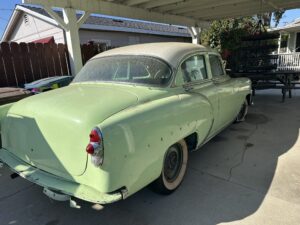
This 1953 Chevrolet 210 VIN Verification was done by our team member in El Monte, Ca. on
11-06-2025

This 1953 Chevrolet 210 VIN Verification was done by our team member in El Monte, Ca. on
11-06-2025
The 1953 Chevrolet 210 represents a defining moment in Chevrolet’s postwar lineup — a bridge between the entry-level 150 and the luxurious Bel Air. As a mid-range model, the 210 offered an appealing mix of affordability, style, and comfort. With its clean new design, improved engineering, and reliable performance, the 1953 Chevrolet 210 became a popular choice among families and everyday drivers, contributing significantly to Chevrolet’s dominance in the early 1950s American car market.
The Chevrolet 210 was introduced in 1952 as a replacement for the Styleline Deluxe series, positioned between the base Chevrolet 150 and the top-trim Bel Air. The 1953 model year marked a major design shift for Chevrolet — it was the first full redesign since World War II, debuting an all-new body style with smoother lines and a more modern look.
Offered in multiple body configurations, the 210 appealed to a broad audience, from families to small business owners. Chevrolet’s marketing emphasized reliability, solid value, and easy ownership — qualities that helped it remain a best-seller throughout the decade.
In 1953, the Chevrolet 210 offered two versions of the famous “Stovebolt Six” inline-six engine, known for its durability and simplicity:
216.5 cu in (3.5L) Inline-6 – 92 horsepower (used in early production).
235.5 cu in (3.9L) “Blue Flame” Inline-6 – 108 horsepower with a manual transmission or 115 horsepower when paired with the Powerglide automatic transmission.
Transmission options included:
3-speed manual
Powerglide 2-speed automatic (optional, offered improved smoothness and convenience).
While modest by later standards, the 210 delivered dependable performance, making it ideal for daily driving and light touring.
The 1953 model year introduced Chevrolet’s “New Look” styling — rounder, sleeker, and more aerodynamic than the boxy postwar designs. Distinctive design and feature highlights included:
Curved windshield and lower beltline for improved visibility.
Full-width chrome grille with vertical center divider.
Two-tone paint options and tasteful brightwork.
Updated dashboard with symmetrical instrumentation and optional clock.
Comfort-oriented interiors, available in broadcloth or vinyl upholstery depending on trim.
The 210 balanced practical simplicity with a touch of flair, making it an attainable upgrade over the entry-level models.
The 1953 Chevrolet 210 was offered in a wide range of body styles to suit different needs and tastes:
2-door sedan
4-door sedan
2-door hardtop (Sport Coupe)
Station Wagon (Handyman 2-door or Townsman 4-door)
Convertible (limited production)
Trim details were more restrained than the Bel Air’s, but the 210 still featured chrome accents, stainless trim, and optional accessories like bumper guards and full wheel covers.
While the 1953 Chevrolet 210 predated modern safety systems, it incorporated several important advancements for its time:
Improved body rigidity with stronger steel construction.
New center-point steering for better handling.
Larger brakes for improved stopping power.
Optional turn signals and seat belts (though not standard).
It was engineered for comfort and control on America’s expanding highway system, with an emphasis on predictable handling and reliability rather than high performance.
Despite its full-size proportions, the 210’s inline-six engines offered respectable fuel economy for the era:
Average fuel economy: 16–20 MPG (depending on transmission and driving style).
The Powerglide automatic sacrificed a bit of efficiency for convenience, while the manual transmission offered slightly better economy.
In 1953, the Chevrolet 210 competed directly with the Ford Mainline, Plymouth Cambridge, and Studebaker Commander. Chevrolet’s strengths lay in its balance of price, durability, and dealer support. The 210 offered more luxury than the entry-level Ford while undercutting premium models like the Bel Air in price — a key reason it was one of America’s top-selling vehicles that year.
When new, the 1953 Chevrolet 210 was priced between $1,700 and $2,200 USD, depending on body style and optional equipment.
Today, values vary significantly:
Driver-quality examples: $12,000–$20,000
Fully restored models: $25,000–$40,000+
Rare configurations (convertibles or wagons): Up to $50,000 or more in show condition.
One of America’s best-selling cars in 1953, helping Chevrolet retain its market leadership.
Celebrated among classic car collectors for its postwar styling and reliability.
Commonly featured in classic car shows and vintage restorations, thanks to easy parts availability and strong community support.
A favorite base for restorations, customs, and hot rods, particularly the two-door coupe and wagon variants.