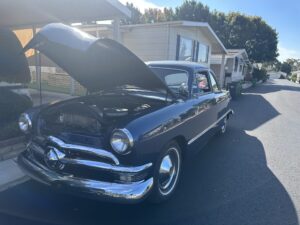
This 1950 Ford Business Copue VIN Verification was done by our team member in Irvine, Ca. on 12-03-2025

This 1950 Ford Business Copue VIN Verification was done by our team member in Irvine, Ca. on 12-03-2025
The 1950 Ford Business Coupe is a classic American two‑door vehicle from the early post‑war era, known for its simple yet purposeful design and utility appeal. The Business Coupe was marketed toward traveling salesmen and professionals who needed cargo space instead of rear passenger seating, making it both practical and distinctive in the early 1950s automotive landscape.
In 1949 Ford introduced a redesigned full‑size car lineup that became known as the “Shoebox Ford” due to its slab‑sided, modern body style. The Business Coupe was part of this range and continued into the 1950 model year as the economy‑oriented two‑door variant with a large cargo area in place of a traditional rear seat. The 1950 model year sat within the Deluxe and Custom Deluxe series, providing buyers with different trim and equipment levels.
Production figures show the 1950 Business Coupe was fairly common in its era, with about 35,120 units built.
The 1950 Ford Business Coupe was typically equipped with:
Flathead V‑8 engines, most commonly the 239 ci (3.9 L) V‑8 producing around 100 hp (SAE) when paired with an overdrive transmission.
Standard gearbox choices included a 3‑speed manual (often with column shift) and available overdrive for improved highway cruising.
Performance by modern standards was modest, with 0‑60 mph times in the mid‑teens, reflecting its role as a practical, everyday vehicle rather than a high‑performance car.
The 1950 Business Coupe retained the clean, slab‑sided aesthetics of post‑war Fords, with a long hood, integrated fenders, and simple grille design. As a business‑oriented model, it lacked a conventional rear seat to provide a flat cargo space behind the front seats, ideal for carrying goods or samples.
Features were basic compared to upscale trims, focusing on utility over luxury. Common equipment included standard cloth or vinyl upholstery and minimal trim, with optional accessories such as heaters or radios available depending on buyer preference.
The Business Coupe was offered within Ford’s Deluxe and Custom Deluxe lines. The Deluxe variant offered essential appointments, while Custom Deluxe versions included additional chrome trim and upgraded interior cues typical of the period.
Unlike the more passenger‑oriented Club Coupe or Tudor Sedan, the Business Coupe prioritized cargo capacity and simplicity.
In 1950, automotive safety technology was rudimentary by modern standards. The Business Coupe featured basic safety equipment typical of the era:
Laminated windshield
Seat belts were not standard at the time
Drum brakes on all wheels
Simple suspension tuned for comfort rather than performance
There were no advanced driver‑assist systems, reflecting the technological norms of early post‑war automobiles.
Exact factory fuel economy figures from 1950 are scarce, but vehicles with the Flathead V‑8 and three‑speed transmissions typically yielded modest fuel economy, often in the 10–15 mpg range under mixed driving conditions due to the engine’s design and heavy curb weights.
In its era, the 1950 Ford Business Coupe competed with similar utility‑oriented passenger cars from Chevrolet and Plymouth, which also offered coupe models with simplified interiors and cargo‑friendly layouts. The Ford’s combination of the reliable flathead V‑8 and straightforward design made it a popular choice among small business owners and enthusiasts alike.