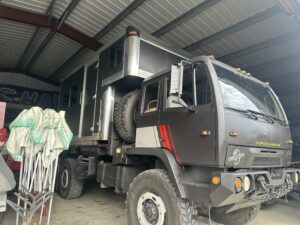
This 1998 Steward Stevenson VIN Verification was done by our team member in Murrieta, Ca. on a Montana VIN Verification form.

This 1998 Steward Stevenson VIN Verification was done by our team member in Murrieta, Ca. on a Montana VIN Verification form.
The 1998 Stewart & Stevenson designation generally refers to a range of heavy‑duty military and commercial vehicles built by Stewart & Stevenson, an American manufacturer known for rugged trucks, tactical vehicles, and industrial equipment. In 1998, models like the M1078 Light Medium Tactical Vehicle (LMTV) and the M1088 6×6 military tractor were produced, primarily for military use but often later adapted for civilian purposes such as overland expedition vehicles or utility trucks.
Stewart & Stevenson originated in 1902 in Houston, Texas, evolving from a blacksmith and carriage repair shop into a prominent manufacturer of military and industrial vehicles. By the 1990s, the company had become a key contractor for the U.S. Army’s Family of Medium Tactical Vehicles (FMTV) program, producing variants like the M1078 and M1088 under contract.
The 1998 Stewart & Stevenson vehicles such as the M1078 LMTV were typically powered by a 6.6L Caterpillar 3116 turbo‑diesel inline‑six engine paired with an Allison 7‑speed automatic transmission. These powertrains were chosen for reliability and torque, suitable for heavy loads and off‑road conditions. The 6×6 M1088 truck tractor also used a diesel engine with automatic transmission, optimized for towing and rugged terrain performance.
Vehicles like the M1078 and M1088 were designed with military utility in mind — featuring robust 4×4 or 6×6 drivetrains, high ground clearance, and durable chassis suitable for harsh conditions. The cabs are utilitarian, often with seating for crew and simple instrumentation, while many surviving examples today have been converted for expedition or recreational use with living quarters, winches, and tire inflation systems.
The 1998 lineup did not have “trim levels” like consumer vehicles but instead included several military variants:
M1078 LMTV 4×4 – light medium tactical cargo and utility vehicle.
M1088 6×6 Truck Tractor – larger military cargo and semi‑tractor truck.
Other variants such as the M1079 (similar LMTV platform) were also produced and sometimes converted for special uses.
Safety features on these military vehicles were primarily functional—built to meet military standards for durability and crew protection rather than modern consumer safety tech. While offering robust construction and in some cases air‑ride suspension for crew comfort, driver‑assist technology was minimal compared to civilian vehicles of the same year.
Fuel economy figures for these trucks are not typically published like consumer vehicles. Given their heavy diesels, large 4×4/6×6 drivetrains, and military specification, fuel efficiency is low relative to passenger cars, with consumption driven by load, terrain, and configuration.
Compared with civilian trucks from 1998, Stewart & Stevenson military vehicles prioritized durability and tactical capability over comfort or fuel economy. Within the military surplus and expedition market, they compete with other tactical truck platforms adapted for civilian use, like the FMTV series from Oshkosh (which took over production later) or surplus Mack/M916 series tractors.
Today, 1998 Stewart & Stevenson trucks trade as surplus or specialty vehicles rather than new vehicles:
An M1078 LMTV might sell in the low‑to‑mid five‑figures depending on condition and conversion.
Customized expedition builds on a 1998 chassis can command significantly more (e.g., high‑end conversions reaching into the hundreds of thousands).
These 1998 vehicles were not mainstream consumer models and therefore did not receive traditional automotive awards. However, the FMTV program, of which the 1998 models were part, has been recognized for its role in modernizing the U.S. military’s logistics and tactical mobility fleet during the late 1990s and early 2000s.